Key takeaway: You cannot maintain what you don’t know you have. Before any compliance programme, PPM schedule or maintenance contract can work effectively, you need a complete, accurate asset list. Understanding the distinction between statutory and non-statutory maintenance — and why both matter — is the foundation of effective facilities management for any UK commercial building.
Why an Asset List is the Starting Point for Everything
Walk into any commercial building in the UK and ask the owner or facilities manager for a complete list of the building’s maintainable assets. In the majority of cases, no such list exists — or if it does, it is incomplete, out of date, or stored in a format that makes it practically useless.
This is not a trivial gap. Without a complete asset list, it is impossible to know what needs to be maintained, what has a statutory inspection requirement, what is approaching end of life, or what the true cost of maintaining the building actually is. Maintenance decisions become reactive rather than planned. Statutory obligations get missed — not through negligence, but through ignorance of what exists.
The asset list — sometimes called the asset register — is the foundation on which everything else in a facilities management programme is built. It is where your statutory compliance programme starts.
What is a Building Asset?
In the context of facilities management, a building asset is any physical component of a building or its services that has a maintenance, inspection or compliance requirement. This is broader than most building owners realise.
The ISO 55000 family of standards — the international framework for asset management, updated in its 2024 edition — defines an asset as any item, thing or entity that has potential or actual value to an organisation. In the built environment, this encompasses:
Structure and fabric
Roof, walls, windows, floors, doors, external areas, car parks, drainage
Mechanical services
Heating systems, boilers, air conditioning, ventilation, lifts, pressurisation units
Electrical services
Electrical distribution, lighting, emergency lighting, fire alarm, security systems, generators
Plumbing and water
Cold water storage, hot water systems, calorifiers, TMVs, showers, drainage, sprinklers
Fire safety equipment
Fire extinguishers, hose reels, fire doors, smoke detectors, suppression systems, dry risers
Specialist systems
Access control, CCTV, BMS, compressed air, specialist ventilation, cooling towers
Each category contains multiple individual assets, each of which may have different maintenance requirements, inspection frequencies, statutory obligations and lifecycle considerations. A medium-sized commercial office building may contain several hundred individually maintainable assets. An industrial facility may contain several thousand.
What Should an Asset List Contain?
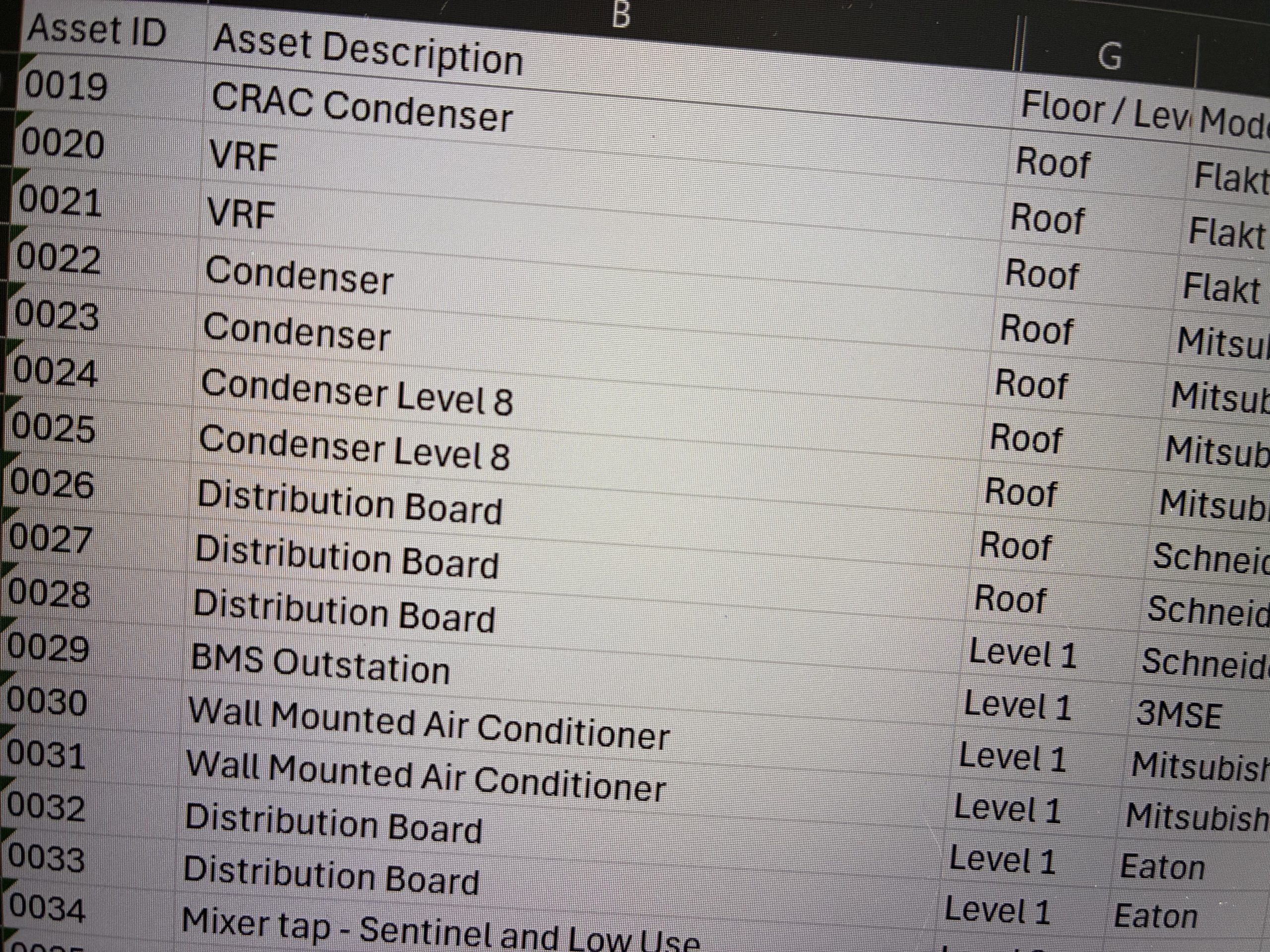
A useful asset list — one that actually drives a maintenance and compliance programme rather than sitting in a filing cabinet — should contain the following information for each asset:
- Asset description — what it is, in plain language
- Location — building, floor, room or plant reference
- Make, model and serial number — essential for sourcing parts, contractors and manufacturer guidance
- Installation or commissioning date — determines age, warranty status and lifecycle position
- Condition — current assessed condition, ideally using a standard condition grading (e.g. 1–5 or RAG rating)
- Statutory inspection requirement — yes or no, with the relevant legislation identified
- Inspection frequency — how often inspection or maintenance is required
- Last inspection date and certificate reference — links to the compliance evidence file
- Next inspection due date — the forward-looking compliance trigger
- Responsible contractor — who carries out the statutory inspection or maintenance
- Estimated replacement cost and replacement year — for lifecycle and capital planning
This level of detail transforms an asset list from a static inventory into a dynamic management tool. It becomes the backbone of your planned preventive maintenance (PPM) programme, your compliance calendar and your lifecycle capital plan.
Statutory vs Non-Statutory Maintenance — Understanding the Distinction
One of the most important — and most misunderstood — distinctions in facilities management is between statutory and non-statutory maintenance. Getting this wrong in either direction creates problems: treating everything as equally urgent wastes resource and budget; treating statutory tasks as discretionary creates legal risk.
Statutory maintenance
Maintenance activities that are required by primary or secondary legislation — Acts of Parliament or Statutory Instruments. Failure to carry them out is a criminal offence.
Examples: Annual fire alarm servicing (Regulatory Reform (Fire Safety) Order 2005), EICR every five years (Electricity at Work Regulations 1989), Legionella risk assessment (COSHH Regulations 2002), asbestos management survey (Control of Asbestos Regulations 2012).
Consequence of non-compliance: Unlimited fines, prosecution, imprisonment, prohibition notices, invalidated insurance.
Non-statutory maintenance
Maintenance activities that are not required by legislation but are required by contract, manufacturer recommendation, industry best practice or operational necessity. Failure to carry them out is not a criminal offence — but the consequences can still be severe.
Examples: Boiler servicing (beyond statutory gas safety requirements), air handling unit filter changes, general building fabric inspections, planned decoration, gutter cleaning, door hardware maintenance.
Consequence of non-compliance: Equipment failure, void warranties, insurance exposure, deterioration of building fabric, increased lifecycle costs and reactive maintenance spend.
The SFG20 definition: SFG20 — the UK’s definitive standard for building maintenance specifications, produced in collaboration with BSRIA, CIBSE and IWFM — defines statutory tasks as anything required by primary legislation such as Acts of Parliament and secondary legislation such as Statutory Instruments. Non-statutory tasks are those that are critical to the operation of a business or a contractual and/or operational requirement, but are not a statutory obligation as determined by primary or secondary legislation.
Why Non-Statutory Maintenance Matters as Much as Statutory
A common mistake made by building owners and inexperienced facilities managers is to treat statutory compliance as the ceiling — the end point of a maintenance programme — rather than the floor. Statutory compliance sets the minimum legal requirement. It does not, in many cases, describe what is needed to keep a building functioning reliably, efficiently and safely over its lifetime.
Consider a commercial boiler. The statutory obligation is an annual gas safety inspection under the Gas Safety (Installation and Use) Regulations 1998. That inspection confirms the appliance is safe to operate. It does not service the burner, clean the heat exchanger, check the controls or optimise combustion efficiency. A boiler that passes its annual gas safety inspection may still be operating at significantly reduced efficiency, may be approaching component failure, and may be consuming substantially more energy than a properly serviced equivalent.
Non-statutory maintenance — in this case, a full annual boiler service — is what keeps the asset performing as intended. It extends asset life, reduces reactive maintenance spend, protects warranty coverage and controls energy costs. The statutory inspection keeps you out of court. The non-statutory service keeps the building running.
A “fix on fail” approach may work for some non-statutory assets. But applied indiscriminately across a building’s asset base, it leads to premature asset failure, increased lifecycle costs, and — in some cases — situations where the failure of a non-statutory maintained asset creates a statutory compliance breach. A failed emergency generator that was not serviced on its recommended schedule creates a compliance exposure, not just an operational one.
The Role of SFG20 in Defining Maintenance Tasks
SFG20, launched in 1990 by the Building Engineering Services Association (BESA) and now developed in collaboration with BSRIA, CIBSE and IWFM, is the recognised industry standard for building maintenance specification in the UK. It provides a comprehensive library of maintenance schedules covering virtually every building service and system.
SFG20 uses a colour-coded task criticality system that maps directly onto the statutory/non-statutory distinction:
- Red tasks — Statutory/Legal: Required by primary or secondary legislation. Non-negotiable. Must be completed at the specified frequency.
- Amber tasks — Optimal/Best Practice: Function-critical and/or industry best practice. Not legally mandated but important for asset performance and operational continuity.
- Green tasks — Discretionary: Desirable maintenance activities that improve performance or extend asset life but are neither legally required nor operationally critical.
A robust PPM programme built on SFG20 schedules ensures that statutory tasks are never missed and that non-statutory tasks are prioritised appropriately based on their operational and financial impact. SFG20 schedules update dynamically as legislation changes, meaning organisations that align their maintenance programmes with SFG20 maintain compliance by design rather than by chance.
ISO 55000 — The International Framework for Asset Management
For organisations looking beyond basic compliance towards a systematic, optimised approach to managing their built assets, the ISO 55000 family of standards provides the international framework. The 2024 edition, published by ISO/TC 251, represents a significant evolution of the discipline since the original 2014 publication.
The ISO 55000 family comprises three core standards:
ISO 55000:2024
Vocabulary, overview and principles. Defines the concepts, terminology and principles of asset management. The 2024 edition includes a stronger focus on the outcomes of asset management activities and a revised set of principles.
ISO 55001:2024
Asset management system requirements. The certifiable standard. Sets out the requirements for establishing, implementing, maintaining and improving an asset management system. Controls the lifecycle of assets to balance performance, risk and cost.
ISO 55002:2018
Guidelines for the application of ISO 55001. Provides practical guidance on implementing the requirements of ISO 55001 across different types of organisation and asset portfolio.
ISO 55001 certification is not a requirement for most UK commercial buildings — it is an aspiration for larger organisations and those managing complex asset portfolios. However, the principles it embeds are relevant at any scale:
- Lifecycle thinking — understanding asset performance and cost across the full asset life, not just in the current period
- Risk-based decision making — prioritising maintenance investment based on the risk and consequence of asset failure
- Value realisation — ensuring that asset management activities deliver value to the organisation, not just compliance
- Documented systems — maintaining records that demonstrate effective asset management to regulators, insurers and auditors
- Continuous improvement — reviewing and improving the asset management programme over time
Asset Verification — Professional Support
For organisations that lack the internal resource to build and maintain a comprehensive asset register, or those seeking independent verification of their asset base, a number of specialist providers offer asset verification audit services. These audits create a digital asset register with details including photographs, location, serial numbers, service records and condition assessments.
There are many that offer asset verification audit services specifically designed for facilities managers and building owners. Their independent evaluations identify defects, deterioration and maintenance needs, providing detailed reports with photographic evidence to support informed asset management decisions.
How to Build Your Asset List — A Practical Starting Point
For most SME business owners, the starting point is a physical walkthrough of the building with a structured template. The goal of the initial exercise is not perfection — it is completeness. A rough list that captures every maintainable asset is more useful than a detailed register that covers only half the building.
A practical approach:
- Start with plant rooms and service areas — these contain the highest concentration of statutory assets. Boilers, calorifiers, electrical switchgear, water storage tanks, air handling units and generator sets are all typically located here.
- Work systematically through the building — floor by floor, room by room. Don’t overlook roof spaces, ceiling voids, external areas and car parks.
- Photograph every asset — a photograph with a date stamp is invaluable. It records condition at the time of survey and provides the evidence base for future condition assessments.
- Note make, model and serial number where visible — this enables you to look up manufacturer maintenance requirements and expected service life.
- Flag statutory inspection requirements immediately — as you identify each asset, note whether it has a statutory inspection requirement so you can prioritise the compliance review.
- Check existing certificates against the asset list — once the list is complete, check whether current statutory certificates exist for every asset that requires them. Gaps in coverage are your immediate compliance priorities.
Once the asset list is complete, it becomes the driver for your PPM schedule — a forward-looking calendar of every maintenance and inspection task, statutory and non-statutory, assigned to the appropriate contractor or in-house resource, with completion tracked and evidence filed.
The Asset List as a Business Asset
A well-maintained, up-to-date asset register has value beyond the immediate compliance and operational benefits. It is increasingly recognised as a material business asset in its own right:
- Property transactions — a comprehensive asset register and associated maintenance history significantly simplifies due diligence in property acquisitions and disposals, and supports accurate valuation
- Insurance — insurers increasingly require evidence of statutory compliance and systematic maintenance. A documented asset register and PPM programme supports favourable underwriting and reduces the risk of claim rejection
- The Building Safety Act 2022 golden thread — for higher-risk buildings, the Act requires the maintenance of a golden thread of building information throughout the building’s life. An asset register is a core component of that golden thread
- Capital planning — lifecycle data from the asset register enables accurate capital replacement forecasting, avoiding the budget shocks that come from unexpected major failures
- Sustainability reporting — asset data increasingly feeds into energy performance, carbon reporting and ESG disclosure requirements
Summary — Key Principles
- ✅ A complete asset list is the foundation of every effective compliance and maintenance programme
- ✅ Statutory maintenance is required by law — failure is a criminal offence with unlimited penalties
- ✅ Non-statutory maintenance is not legally mandated but is essential for operational continuity, asset longevity and insurance protection
- ✅ SFG20 provides the UK’s definitive framework for categorising maintenance tasks by statutory status and criticality
- ✅ ISO 55000:2024 provides the international framework for systematic asset management — its principles are relevant at any scale
- ✅ Asset verification audits from specialist providers can establish a comprehensive asset register where internal resource is limited
- ✅ A well-maintained asset register has value beyond compliance — in property transactions, insurance, capital planning and regulatory reporting
- ✅ Statutory compliance is the floor, not the ceiling — a maintenance programme built only to the statutory minimum will underperform and cost more over the long term
Want audit-ready working documents for every compliance area?
Our UK Statutory Compliance Audit Toolkit gives you five professionally designed, legislatively referenced documents — fire safety, Legionella, asbestos, electrical and a master compliance log. Ready to complete and file.
Get the Audit Toolkit — £39Related guides
Don’t Know What Assets You Have or Whether They’re Compliant?
Faciliteeez provides statutory compliance audits and asset management reviews for UK commercial premises. We’ll tell you exactly what you have, what needs maintaining, and what’s at risk. Book a no-obligation consultation today.
Book a Compliance Audit Browse All Guides