What the Responsible Person Must Do Under the Fire Safety Order — A Plain-English Guide
Key takeaway: If you are in control of a non-domestic premises in the UK, you are almost certainly the Responsible Person under the Regulatory Reform (Fire Safety) Order 2005. This carries significant legal duties — and failure to comply can result in unlimited fines and imprisonment. Similar legal duties exist for water systems — see our guide to Legionella compliance under ACOP L8.
What is the Regulatory Reform (Fire Safety) Order 2005?
The Regulatory Reform (Fire Safety) Order 2005 — commonly referred to as the Fire Safety Order or FSO — is the primary piece of legislation governing fire safety in non-domestic premises in England and Wales. Similar legislation applies in Scotland and Northern Ireland.
The FSO applies to virtually all non-domestic premises including offices, shops, restaurants, hotels, warehouses, factories, schools, care homes and shared areas of multi-occupied residential buildings.
At the heart of the FSO is the concept of the Responsible Person — the individual or organisation on whom all fire safety duties are placed.
Who is the Responsible Person?
The Responsible Person is defined in Article 3 of the FSO. In most workplaces, the Responsible Person is:
- The employer if the workplace is to any extent under their control
- The person in control of the premises in connection with carrying on a trade, business or other undertaking (for profit or not)
- The owner where the person in control does not have control in connection with carrying on a trade or business
In practice, for most SME business owners, you are the Responsible Person. This applies whether you own the building, lease it or simply operate a business from it. If you have control over the premises, the duty falls to you.
There can be more than one Responsible Person for a premises — for example in a multi-tenanted building where both the landlord and individual tenants may each hold duties for different parts of the building.
Important: Being the Responsible Person cannot be delegated away simply by appointing a facilities manager or a fire safety consultant. You can delegate tasks — but not the legal responsibility itself. The duty remains with you.
What Must the Responsible Person Do?
The FSO places the following core duties on the Responsible Person:
1. Carry Out and Record a Suitable and Sufficient Fire Risk Assessment
This is the cornerstone duty. Article 9 of the FSO requires the Responsible Person to carry out — or appoint a competent person to carry out — a suitable and sufficient fire risk assessment of the premises.
The fire risk assessment must:
- Identify fire hazards within the premises
- Identify people at risk
- Evaluate, remove or reduce the risks
- Be recorded in full — see recording requirement below
- Be reviewed and updated regularly or when significant changes occur
Recording requirement — updated by the Building Safety Act 2022: Article 9(6) of the FSO, as amended by the Building Safety Act 2022 and in force from 1 October 2023, requires the Responsible Person to make a record of the assessment as soon as practicable after it is made or reviewed. This applies to all Responsible Persons regardless of the number of employees. The full findings of the assessment must be recorded. There is no longer any employee number threshold.
There is no set frequency for reviewing a fire risk assessment — Article 9(3) of the FSO requires it to be reviewed when there is reason to suspect it is no longer valid or when there has been a significant change to the premises, the occupancy, the use or the fire precautions.
2. Implement and Maintain Appropriate Fire Precautions
Based on the findings of the fire risk assessment, the Responsible Person must implement and maintain general fire precautions under Article 8 of the FSO. These include:
- Means of escape (Article 14): Adequate escape routes that are kept clear and unobstructed at all times
- Fire detection and warning (Article 13): An appropriate fire detection and alarm system, regularly tested and maintained
- Emergency lighting: Where needed, emergency lighting to illuminate escape routes in the event of power failure
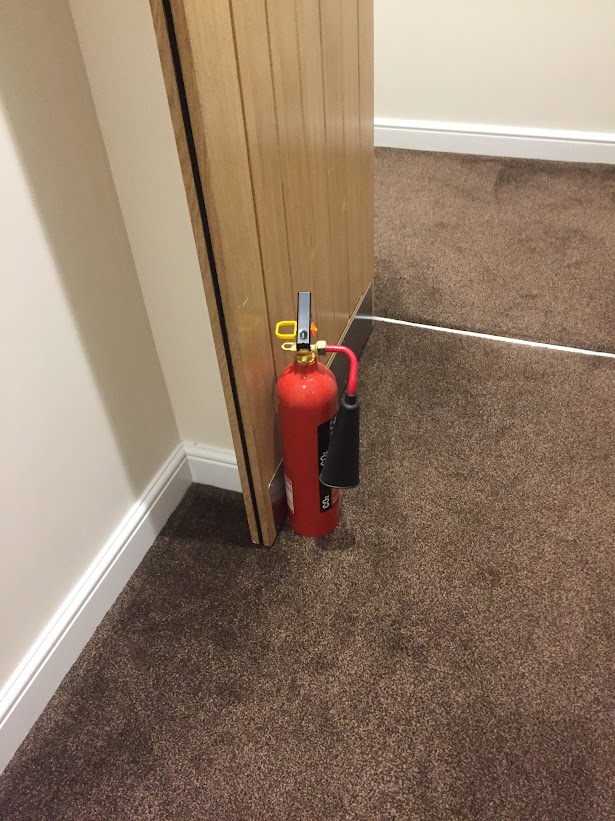
- Fire fighting equipment (Article 13): Appropriate fire extinguishers of the correct type, correctly located, regularly inspected and maintained
- Fire doors: Properly installed, maintained and not propped open
- Signage: Correct fire safety signs including exit signs, fire action notices and fire extinguisher identification signs
3. Establish and Maintain an Emergency Plan
Under Article 15 of the FSO, the Responsible Person must establish and where necessary document an appropriate emergency plan covering:
- What to do in the event of a fire
- How to raise the alarm
- Evacuation procedures and assembly points
- Arrangements for people who may need assistance to evacuate
- Liaison arrangements with the fire and rescue service
4. Provide Fire Safety Information and Training
Article 21 of the FSO requires every employee to receive adequate fire safety information and training. This must include:
- The fire risks identified in the fire risk assessment
- The preventive and protective measures in place
- What to do if a fire breaks out
- How to use fire fighting equipment where appropriate
Training must be provided on induction for new employees and repeated regularly. There is no prescribed frequency in the FSO, but annual fire safety training refreshers are considered good practice and are expected by enforcing authorities.
5. Appoint Competent Persons
Under Article 18 of the FSO, the Responsible Person must appoint one or more competent persons to assist with undertaking the preventive and protective fire safety measures. A competent person is someone with sufficient training, experience and knowledge to implement the required measures. This may be the Responsible Person themselves, an employee or an external fire safety specialist.
What Records Must Be Kept?
Under Article 9(6) of the FSO as amended by the Building Safety Act 2022 (in force from 1 October 2023), all Responsible Persons must record their complete fire risk assessment as soon as practicable after it is made or reviewed. There is no employee number threshold — this duty applies to all Responsible Persons regardless of workforce size.
Beyond the fire risk assessment itself, you should maintain records of:
- Fire risk assessment reviews and updates
- Fire alarm test records (weekly call point tests)
- Emergency lighting test records (monthly flick tests and annual discharge tests)
- Fire extinguisher inspection and service records
- Fire door inspection records
- Fire evacuation drill records
- Fire safety training records for all staff
These records form your compliance evidence. In the event of an inspection by the Fire and Rescue Authority, or following a fire incident, these records demonstrate that you have discharged your duties as Responsible Person. For a complete overview of all statutory inspection requirements, see our UK statutory compliance guide.
What Are the Consequences of Non-Compliance?
Enforcement of the FSO is carried out by the local Fire and Rescue Authority under Article 25. Inspectors have the power to:
- Issue Enforcement Notices under Article 30 requiring remedial action within a specified timeframe
- Issue Prohibition Notices under Article 31 restricting or prohibiting use of the premises immediately
- Prosecute the Responsible Person for breaches of the FSO under Article 32
Penalties for FSO breaches under Article 32 are severe. On summary conviction fines are unlimited. On indictment the Responsible Person can face up to two years imprisonment. Non-compliance may also invalidate your buildings insurance.
Real example: A Nottingham lettings company director was fined £150,000, given a suspended prison sentence and ordered to pay £45,000 in costs after failing to provide a fire risk assessment, adequate means of escape, fire detection, emergency lighting and fire safety training for staff — despite being given an extended period to comply.
The Building Safety Act 2022 — What Changed?
The Building Safety Act 2022 significantly strengthened the fire safety regime in the UK, particularly for higher-risk buildings. Key changes affecting all Responsible Persons include:
- Article 9(6) amended — all Responsible Persons must now record their complete fire risk assessment regardless of employee numbers (in force 1 October 2023)
- Article 9(7)(a) amended — the full findings must be recorded, not merely the significant findings
- Strengthened duties to share fire safety information with other Responsible Persons in the same building under Article 22
- New Article 22A — duty to provide fire safety information to a new Responsible Person when control of premises changes
- New Article 22B — duty to cooperate with accountable persons in higher-risk buildings
- New Principal Accountable Person role for higher-risk buildings (over 18 metres or 7 storeys with at least 2 residential units)
Even if your premises are not a higher-risk building, the Building Safety Act 2022 has raised the bar on fire safety compliance expectations across all non-domestic premises. The Act also strengthened asbestos management duties — read our guide to the duty to manage asbestos under the Control of Asbestos Regulations 2012.
Summary — Responsible Person Duties Checklist
- ✅ Carry out a suitable and sufficient fire risk assessment (Article 9)
- ✅ Record the complete findings of the fire risk assessment as soon as practicable (Article 9(6) as amended)
- ✅ Review the fire risk assessment when circumstances change (Article 9(3))
- ✅ Implement and maintain appropriate fire precautions (Article 8)
- ✅ Ensure escape routes are adequate and unobstructed (Article 14)
- ✅ Install, test and maintain fire detection and alarm systems (Article 13)
- ✅ Install, test and maintain emergency lighting
- ✅ Provide and maintain appropriate fire fighting equipment (Article 13)
- ✅ Maintain fire doors correctly
- ✅ Establish and document an emergency plan (Article 15)
- ✅ Provide fire safety information and training to all employees (Article 21)
- ✅ Appoint competent persons to assist with fire safety (Article 18)
- ✅ Keep records of all fire safety activities and tests
- ✅ Share fire safety information with other Responsible Persons in the building (Article 22)
All article references are to the Regulatory Reform (Fire Safety) Order 2005 (SI 2005/1541) as amended, available at legislation.gov.uk. Amendment references relate to the Building Safety Act 2022 (c.30) as applied from 1 October 2023.
Want audit-ready working documents for every compliance area?
Our UK Statutory Compliance Audit Toolkit gives you six professionally designed, legislatively referenced documents — fire safety, Legionella, asbestos, electrical, gas and a master compliance log. Ready to complete and file.
Get the Audit Toolkit — £39Related guides
Not Sure if You’re Compliant?
Faciliteeez provides statutory compliance audits for UK commercial premises. Book a no-obligation consultation today.
Book a Compliance Audit Browse All Guides